Structural Benchmark 1: Linear Elastic Bracket Under Variable Pressure Loading
Problem Overview
This benchmark defines a 3D linear elasticity problem for a mechanical bracket subjected to variable pressure loading. The goal is to develop a data-driven surrogate model that can predict the structural response (stress fields) for any pressure value within a specified range.
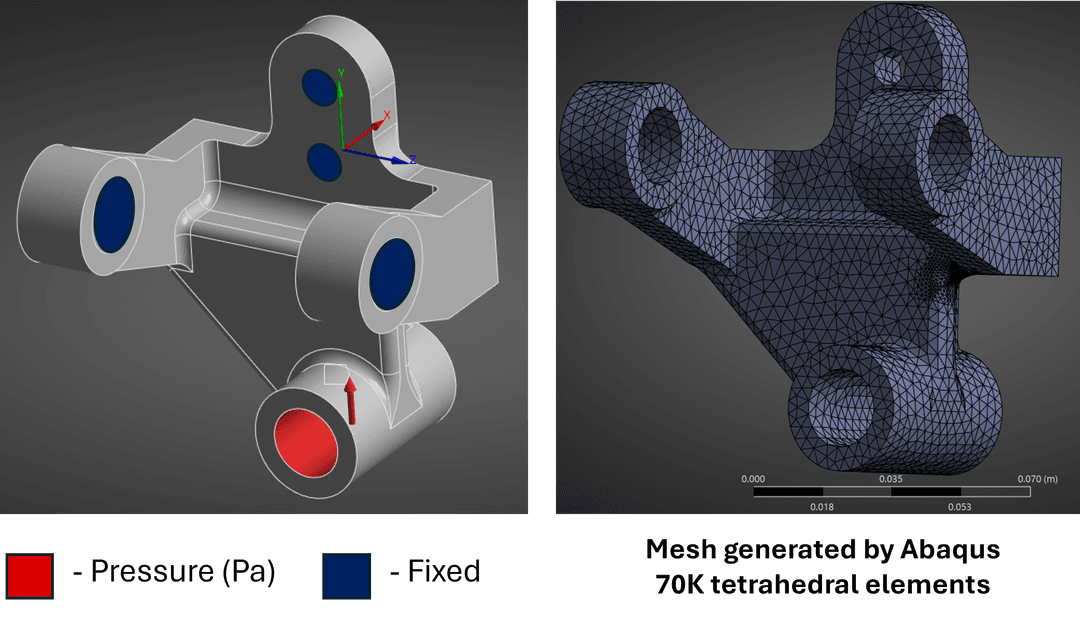
Boundary Conditions
| Boundary Type | Location | Description |
|---|---|---|
| Fixed Support | Four upper cylindrical holes | Fully constrained (u = v = w = 0) - prevents all translation |
| Pressure Load | Bottom cylindrical hole surface | Applied pressure (parameter to be varied) |
Design Parameter
| Parameter | Symbol | Range | Units |
|---|---|---|---|
| Pressure | P | 10,000 - 20,000 | Pa |
The pressure is applied as a pressure load on the inner cylindrical surface of the bottom mounting hole.
Physics: 3D Linear Elasticity
Governing Equations
The problem is governed by the equilibrium equations of linear elasticity:
∇ · σ + f = 0
where: σ is the Cauchy stress tensor, f is the body force vector (typically zero for this problem)
Constitutive Relation (Hooke's Law)
σ = C : ε
For isotropic materials:
σij = λεkkδij + 2μεij
where: λ, μ are Lamé parameters, εij is the strain tensor
Strain-Displacement Relation
ε = ½(∇u + ∇uT)
where u = (u, v, w) is the displacement vector.
Material Properties
Standard structural material properties should be assumed (e.g., steel or aluminum). Typical values:
| Property | Symbol | Typical Value (Steel) | Units |
|---|---|---|---|
| Young's Modulus | E | 200 | GPa |
| Poisson's Ratio | ν | 0.3 | - |
| Density | ρ | 7850 | kg/m³ |
Mesh
The finite element mesh consists of:
- Element Type: Roughly 70K 3D tetrahedral (quadratic, 10 nodes) elements
- Mesh Refinement: Higher density near stress concentration areas (holes, fillets)
Output Quantities of Interest
The data-driven model should predict:
1. Von Mises Stress
σVM = √[½((σ₁-σ₂)² + (σ₂-σ₃)² + (σ₃-σ₁)²)]
Data-Driven Approach
Data Generation
- Sample 35 pressure values uniformly or via Latin Hypercube Sampling in range [10,000, 20,000] Pa
- Run FEA simulations for each pressure value
- Extract nodal stresses
- Split 35 simulation results into 30 for train and 5 for test dataset
Surrogate Model Requirements
- Input: Total 4D: 3D Space (x,y,z) + 1D Parameter (Pressure value P ∈ [10,000, 20,000] Pa)
- Output: Total 1D: Von Mises stress
- Target Accuracy: Less than 1% RMSE test error
Problem Summary
| Aspect | Specification |
|---|---|
| Problem Type | 3D Linear Elasticity |
| Geometry | Mechanical Bracket |
| Parameter | Pressure (10,000 - 20,000 Pa) |
| Boundary Conditions | Fixed supports, Pressure load |
| Output | Von Mises stress field |
Benchmark Results
Benchmark Comparison
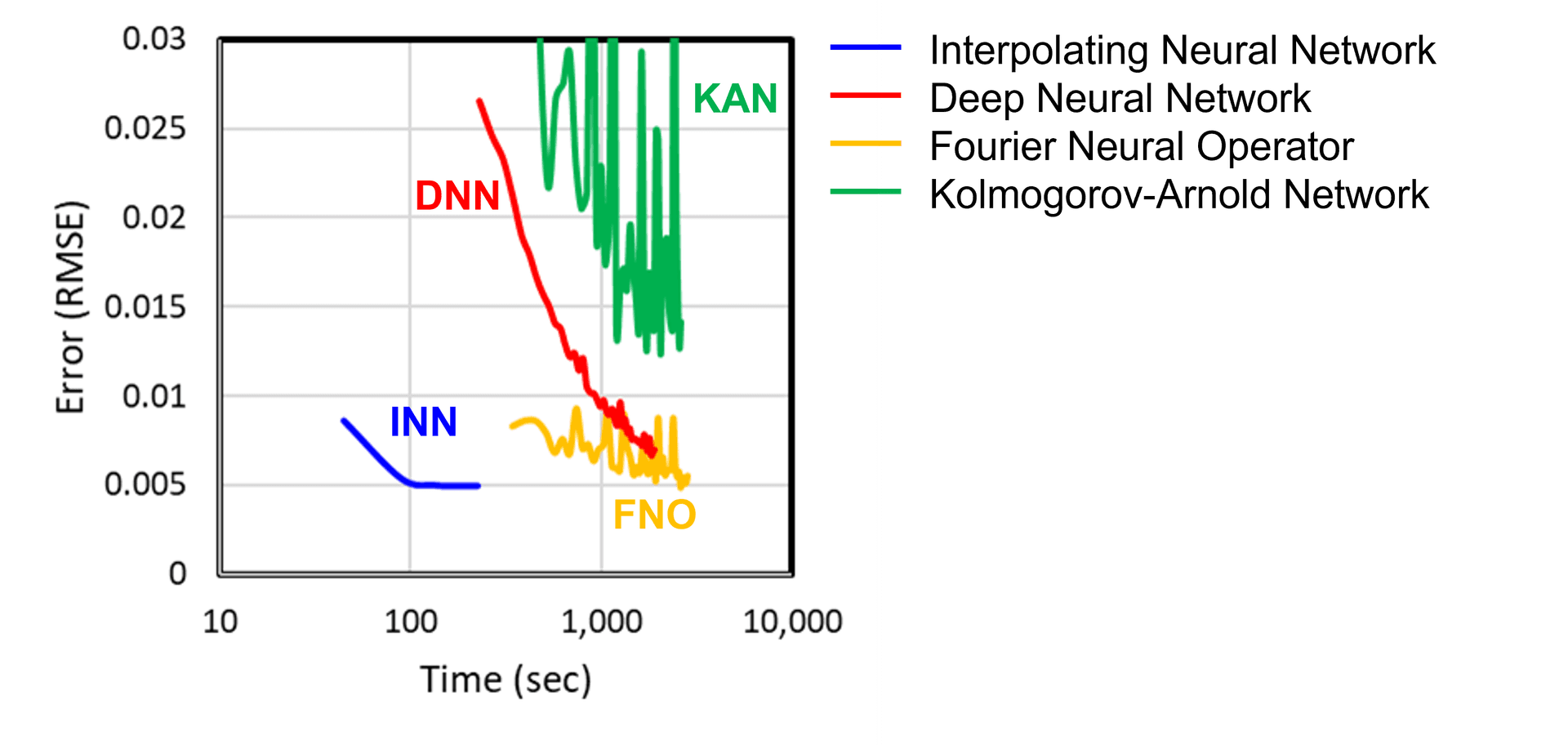
Models Compared
| Model | Full Name | Description |
|---|---|---|
| INN | Interpolating Neural Network | Neural network with interpolation-based architecture |
| DNN | Deep Neural Network | Standard fully-connected deep neural network |
| KAN | Kolmogorov-Arnold Network | Network based on Kolmogorov-Arnold representation theorem |
| FNO | Fourier Neural Operator | Neural operator learning mappings in Fourier space |
Results Summary
| Model | Final RMSE | Training Time | Target Met (<1%) |
|---|---|---|---|
| INN | ~0.005 | ~50-100 sec | Yes |
| FNO | ~0.005-0.008 | ~500-2000 sec | Yes |
| DNN | ~0.009 | ~300-3000 sec | Yes |
| KAN | ~0.010-0.025 | ~1000-3000 sec | Marginal |
Key Observations
- INN achieves fastest convergence - Reaches target accuracy (~0.5% RMSE) in under 100 seconds
- FNO provides stable low error - Consistent ~0.5-0.8% RMSE with moderate training time
- DNN shows steady improvement - Converges to target but requires longer training
- KAN exhibits high variance - Oscillating error during training, slowest to stabilize
Hardware Configuration
| Component | Specification |
|---|---|
| GPU | NVIDIA GeForce RTX 5080 |
| VRAM | 16 GB |
Conclusions
- Best Performance: INN demonstrates superior efficiency with fastest convergence and lowest error
- All models except KAN reliably achieve the <1% RMSE target accuracy
- Trade-off: INN offers 10-20x speedup compared to other methods for this benchmark